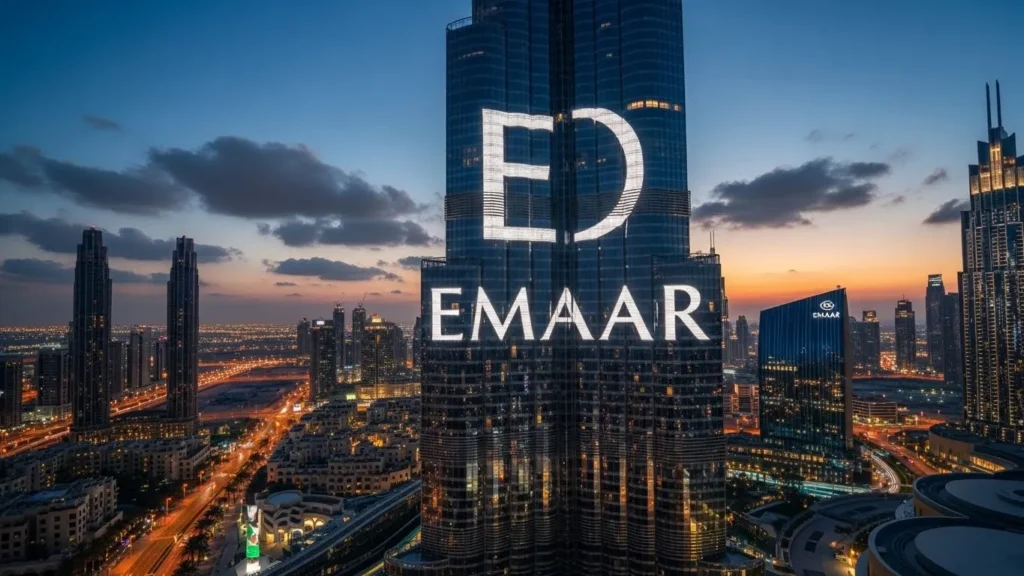
When you stroll through Downtown Dubai and gaze upon the shimmering towers, elegant walkways and sprawling malls, you’re looking at more than concrete and glass. You’re witnessing a transformation — one sparked by vision, built on ambition, and executed by Emaar Properties PJSC. This is the story of how a company born in the desert didn’t just build homes, it helped redefine how people live in the UAE.
The Vision That Started It All
Emaar was founded in 1997 by Mohamed Alabbar as part of Dubai’s broader push to diversify away from oil and turn into a place of global ambition. According to Forbes Middle East, Alabbar’s vision led to Emaar being established in June 1997 and the company building landmark projects that now define Dubai’s identity.
Emaar’s official “About Us” page states that as of 31 December 2023, it had net asset value of AED 177.5 billion (US$ 48.3 billion) and described itself as “among the most admired and valuable real-estate development companies in the world”.
From very early on, Emaar’s ambition was not small: to build integrated developments, world-class communities and places that felt global yet rooted in Dubai.
Landmark Projects: More Than Buildings
Projects like the Burj Khalifa and the Dubai Mall are the physical proof of Emaar’s ambition. According to the company’s 2024 press release, Emaar recorded its highest-ever property sales of ~AED 70 billion (US$ 19 billion) in 2024, an increase of 72% over 2023.
The revenue backlog from property sales passed AED 110 billion (US$ 30 billion).
The “skyline” of Dubai literally changed and the world began to associate luxury, scale and design with the city and with Emaar’s name.
Building Communities, Not Just Towers
Emaar didn’t stop at one landmark. It launched master-planned communities such as Dubai Hills Estate, Arabian Ranches and Emaar South which combine homes, parks, schools, shopping and transport.
In its results for H1 2024, Emaar reported property sales reaching AED 31.5 billion (US$ 8.6 billion), a 56% increase year-on-year, with a backlog of AED 90.1 billion (US$ 24.5 billion) as of June 2024.
By focusing on “live, work, play” rather than only building homes, Emaar helped redefine what urban living in the UAE looked like—open spaces, connectivity and lifestyle all built in.
Financial Strength And Growth
To build at this scale requires financial muscle. Emaar’s 2024 figures show that the company posted revenue of AED 35.5 billion (US$ 9.6 billion) for the year.
In the earlier nine-months of 2024, a report showed that Emaar recorded total revenues of AED 23.8 billion (US$ 6.5 billion) and a net profit before tax of AED 12.4 billion (US$ 3.4 billion) with property sales of AED 50 billion and backlog crossing AED 100 billion.
These numbers show one thing: Emaar isn’t just building—it’s delivering, consistently growing and maintaining a strong financial base.
Diversification Into Retail, Hospitality and International Markets
Emaar’s ambition extended beyond homes. It expanded into retail (malls), hospitality (hotels) and international real-estate. The “About” section notes its competencies in real-estate, retail & shopping malls, hospitality and leisure.
By spreading into adjoining sectors, Emaar reduced reliance on one revenue stream and reinforced its brand as a comprehensive lifestyle company, not just a developer of buildings.
Timing, Local Ecosystem and Global Relevance
The success of Emaar aligns with Dubai’s wider strategy of becoming a global city. The Oxford Business Group points out that tech-driven start-ups and property development are core contributors to Dubai’s economic diversification.
With infrastructure, regulations and geographic location on its side, Emaar was able to build at scale, attract global investors, and help turn the UAE into a destination for both living and investment.
Land Bank and Future Pipeline
To sustain its scale, Emaar holds a large land-bank. The 2025 press release for H1 shows that Emaar’s backlog reached AED 146.3 billion (US$ 39.8 billion) as of 30 June 2025, with land-bank-scale and future visibility of growth.
Having such a pipeline enables long-term planning and signals to both residents and investors that this is a company building for decades, not months.
Strategy & Lessons: What This Story Teaches
If we extract lessons from Emaar’s journey, here are some important ones for founders, policymakers and investors:
- Align vision with national ambition. Emaar’s goals matched Dubai’s plan to become a global city.
- Focus on lifestyle value, not just units. The shift from simply selling apartments to building communities differentiates the brand.
- Diversify into adjacent sectors. Retail, hospitality and international expansion broadened Emaar’s reach.
- Build scale and pipeline. Backlog, land-bank and financial growth make the business more resilient.
- Leverage ecosystem advantages. Infrastructure, regulation, global talent and investment environment all matter in scaling big.
Impact: Redefining Urban Living in the UAE
Put simply, Emaar’s work changed how people think about living in the region. Instead of just homes, the UAE now offered modern communities, global-standard amenities and landmark developments. When someone chooses to stay in a Emaar-developed community, they are choosing more than an address—they are choosing a lifestyle.
The data backs it: property sales hitting tens of billions of AED, backlogs that guarantee future revenue, and projects that receive international attention. Emaar helped turn the desert into a skyline—and in that act helped the UAE redefine urban living for an entire region.
Final Words
From desert to skyline, Emaar’s story is a testament to what vision, execution and scale can achieve. Standing tall amidst skyscrapers and cityscapes, one realises this is more than real-estate development—it’s nation-building, community-making and future-shaping.
If you’re reading this and imagining your own venture—whether in real estate, technology or community building—the lesson is clear: start with a strong idea, align with your environment, build for the long term—and remember that the skyline you see today might just be the beginning of what the desert can become.